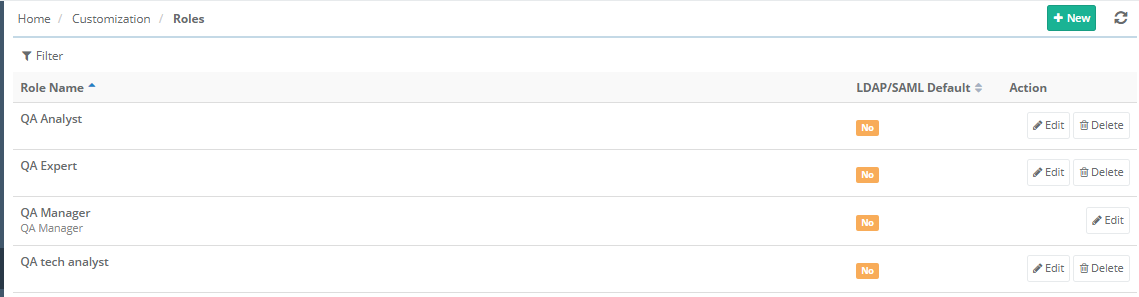
Roles
A user role defines user’s capability to access the modules and carry out functions assigned to that role. Admin, QA Manager, Read only, and Tester are the default roles in QMetry.
A QMetry Admin can create custom roles in addition to the mentioned default roles. The admin can assign these custom roles to individual QMetry users.
On login, you see only the modules your role allows. Features without permission appear disabled.
Creating a User Role
To create a new user role, perform these steps:
Expand Customization and select Roles on the side bar.
Click New.

Enter the following details:
Role Title: Enter name of the user role.
Role Description: Enter description of the user role.
Make this the default role for new LDAP/SAML users: Select the check-box to make the role to be assigned by default to every new LDAP/SAML user for the Project.
Module Permissions
Permissions available if Customization App is enabled
The matrix of Modules and Rights are available on the screen. Admins can choose to provide selective rights for the different modules.
Permissions | Implications |
|---|---|
View | View the module. |
Create | Create new records for the module. |
Modify | Update the details of the module. Archive or Unarchive folder and asset permissions are included under modify rights. |
Delete | Delete the records of the module. |
Execute | Execute test case and test suite. |
Import | Import entities like requirement, test case, test suite and issue. |
Export | Export entities like requirement, test case, test suite and issue. |
Link | Link entities like requirement, test case, test suite and issue. |
Copy | Copy entities like requirement, test case, test suite and issue. |
Versioning | Create and manage versions of requirement and test case. |
Admin can also choose to Apply or Clear all rights using the following buttons.
Apply All Rights: Assign all rights of all modules to the Role at once.
Clear All Rights: Unselect the selected Permission check boxes in one go.
Note
The permissions are assigned to a Role. It means all the users with that role for that project will have similar rights over the modules.
![]() |
Test Suite Execution and Modification:
With Execute Permissions:
With Execute test suite permissions, you can:
Execute the test suite.
Modify the assignee and planned date, either before or during execution.
However, you cannot alter any other details related to the test suite. This setup ensures that testers can self-assign executions and plan their executions accordingly.
With Test Suite Modify Permissions:
With "Test Suite Modify" permissions, you can:
Modify test suite details.
Update the execution assignee and planned date on the Test Suite Execute page.
You cannot execute the test cases but can assign testers and plan executions as per the release schedule.
User Module: The system keeps these rights independent. It separates user creation from user deactivation, so teams can create users without having permission to deactivate existing users.
Create or Update
Activate or Deactivate
Delete
Project module: These rights are independent. You can assign Create, Modify, Clone, and Delete permissions separately to only the users who need them.
Note
These rights apply only to the project. You manage release and cycle rights separately.
System admin can regulate project admin permissions.
Project Create: You can create a new project.
Project Modify: You can Modify and Archive Project.
You can assign User roles in projects.
You can integrate Source Code Repository, rename Projects, and change other project settings.
Project Clone: You can clone projects that are assigned to you.
Project Delete: You can delete projects that are assigned to you. This permission does not apply to the deletion of the release and cycle.
Release/Cycle:
![]() |
System admin can regulate Release and Cycle permissions as follows:
View - View rights enables you to view Releases and Cycles.
Create - Create allows creating Release and Cycle for a particular project.
Modify - Modify allows modifying the Releases and Cycle and archiving the Release and Cycle.
Delete - Delete allows deleting the Releases and Cycles.
Note
To generate the Automation API Key, you should have Automation “Modify” and Integration “Modify” rights.
Automation: With “Modify” rights, you can import automation results and create assets in QMetry. You can also configure and use QMetry Automation Agent to schedule and trigger executions.
Integration: “View” rights enables you to view Integration and Jira Scheduler Status. With “Modify” rights, you can integrate the external trackers with QMetry projects, map external tracker issue types with the QMetry Requirement or Issue module, configure custom Jira fields for QMetry modules, and sync Jira issues and/or its project metadata.
Report: QMetry System Reports module is visible only if you have “View” rights for Report. Similarly, you can make any changes within the module only if they have the “Modify” rights for the Report.
Admin Report: Login Summary Dashboard and Gadgets are accessible if you have the “View” rights for Admin Report. You can make changes in the reports if you have the “Modify” rights for the Admin Report.
Permissions | Implications |
|---|---|
View | You can do the following:
|
Modify |
|
QMetry Insight: With “View” rights, you can view Custom Gadgets. With “Modify” rights, you can write custom queries in QMetry and save them as gadgets. It allows you to modify created custom gadgets.
Report Module Rights | QMetry Insight Module Rights | |||
|---|---|---|---|---|
View | Modify | View | Modify | Permissions |
Y | N | NA | NA | You can view System reports and shared dashboard. |
Y | Y | NA | NA | You can view System reports, create custom dashboard and view shared dashboard. |
NA | NA | Y | N | You can view Custom Gadgets. |
NA | NA | Y | Y | You can write custom queries in QMetry and save them as gadgets. Modify right allows you to modify your created custom gadgets. |
Report Module Rights | QMetry Insight Module Rights | ||
|---|---|---|---|
View | Modify | View | Modify |
Y | N | NA | NA |
Y | Y | NA | NA |
NA | NA | Y | N |
NA | NA | Y | Y |
CICD Rule:
View: With only “View” permission for the CICD Rule module, you can just view the CICD module but cannot perform any action.
Modify:
Manage: With “Manage” permission for the CICD Rule module, you can add and edit the CICD Rules configuration.
Delete: With “Delete” permission for the CICD Rule module, you can delete the configured CICD Rules.
Execute: With “Execute” permission for the CICD Rule module, you can execute the configured CDCD Rules.
QMetry Intelligent Search:
Permission | Implications |
|---|---|
View | With only “View” permissions for QI Search , you can just view the Project Documentation Configuration. |
Modify | With the QI Search “Modify” permissions, you can configure the project-specific documentation for AI search. |
Flaky Score:
View: It allows you to view Flaky Score configuration.
Generate: It allows youto generate the Flaky Score. Admin and QA Manager roles have this permission by default.
Modify: It allows you to modify the configuration for generating the Flaky Score. Admins have this permission by default.
Success Rate:
View: It allows you to view the Success Rate configuration.
Generate: It allows you to generate the Success Rate. Admin and QA Manager roles have this permission by default.
Modify: It allows you to modify the configuration for generating the Success Rate. Admins have this permission by default.

Once you have allocated the rights, click Create to create the user role with the permissions.
Permissions if Customization App is Disabled
Admin can assign "View" and "Modify" rights for the following modules:
Requirement
Test Case
Test Suite
Issue
The matrix of Modules and Rights are available on the screen. Admins can choose to provide selective rights for the different modules.
Permissions | Implications |
|---|---|
View | It allows you to view the module. |
Modify | It allows you to update the details of the module. |
Admin can also choose to Apply or Clear all rights using the following:
Apply All Rights: Assign all rights of all modules to the Role at once.
Clear All Rights: Unselect the selected Permission check boxes in one go.
Note
The permissions are assigned to a Role. It means all the users with that role for that project will have similar rights over the modules.
![]() |
After allocating the rights, click Create to create the user role with the permissions.
Editing User Roles
Expand Customization and select Roles on the sidebar.
Click Edit for the role to edit.
Make the required changes and click Update.
Deleting User Roles
Expand Customization and select Roles on the side bar.
To delete a user role, click Delete.
QMetry Report Rights
"View" Report right: Can view System reports and shared dashboard.
"View" and "Modify" Report rights: Can view System reports, create custom dashboards and view shared dashboards.
"View" QMetry Insight right: Can view Custom Gadgets.
"View" and "Modify" QMetry Insight rights: Can write custom queries in and save them as gadgets. Modify right allows you to modify your created custom gadgets.