QMetry Offline Upgrade Guide for Linux (from below v8.16.0.1 to the latest version)
Note
If your current version is below v8.16.0.1, update the Single Sign-On (SSO) login URL.
To update the SSO, refer to Changes in SSO URL in QMetry Onpremise for v8.27.0.
Update the Automation API to the latest version when upgrading QMetry to the latest release.
To update the Automation API, refer to Install/Upgrade Automation API Feature for Offline Installations
This document is intended for customers running QMetry on Linux. It outlines the steps to upgrade QMetry from an older version (below v8.16.0.1) to the latest available release in offline mode.
System Requirements and Pre-requisites
Before upgrading, ensure the following:
Prepare the upgrade files on a machine that has internet access.
After preparing the files, move them to the server along with the
QMetry_Linux_Installer.zipfileInstall Docker before running the Docker commands on the machine.
Downloading Docker Images of QMetry
To download the Docker Images of QMetry, perform the following steps:
Step 1. Logging into Docker
Log in to Docker with the following command:
docker login
Enter your login credentials.
If you do not have the credentials, please get in touch with QMetry Support
Step 2: Pulling the QMetry Docker Image
Pull the latest QMetry application Docker image with the following command:
docker pull qmetry/qmetry:latest
Once the process completes, you’ll see the message:
Downloaded newer image for qmetry/qmetry:latest
docker.io/qmetry/qmetry:latest
Run the following command to verify that the Docker image has been successfully downloaded:
docker images
 |
Step 3: Saving the QMetry Docker Image as a .tar File
Run the following command to save the QMetry application’s Docker image as a .tar file.
You may modify the file path as needed in the following command:
docker save -o /opt/qtm/qmetryapp.tar qmetry/qmetry:latest
 |
Step 4: Downloading and Saving Alpine’s Docker Image.
Run the following commands
docker pull alpine:latest
docker save -o /opt/qtm/alpine.tar alpine:latest
docker images
Step 5. Transfer the qmetryapp.tar and alpine.tar files to the QMetry application server.
Upgrading QMetry to the Latest Version
System Requirements and Pre-requisites
Before upgrading, ensure the following:
MySQL version of QMetry Reports and QMetry Application is 8.4.8.
After installing the new Docker image, reconfigure SSL.
Note
Update all packages on the host OS where the Docker container is installed.
After upgrading to QMetry v8.10.3 and above, perform the following steps to update host OS packages.
Stop the Docker service.
Command may be Linux dependent, but it can be like
service docker stop
or
systemctl stop docker
Update all the packages of the host OS. Command may be Linux OS dependent, but it can be like
sudo yum update -y
or
sudo apt-get update -y
Step 2 will upgrade the version of Docker to the latest available version.
Start the Docker service. Command may be Linux OS dependent, but it can be like
service docker start
or
systemctl start docker
Upgrading Existing QMetry Installation
To upgrade your existing QMetry installation, perform the following steps:
Step 1: Important: Backing up your existing QMetry Database
Create a backup of the "qmetry" database. By default, the backup is saved in the /opt directory.
Run the following command to update the username, password, and backup file location.
docker exec qmetryapp_db sh -c 'exec mysqldump -uroot -p<password> --triggers --routines --hex-blob --single-transaction --lock-tables --no-create-db qmetry' > /opt/qmetry_backup_<date>.sql
Example 10.docker exec qmetryapp_db sh -c 'exec mysqldump -uroot -pqmetry --triggers --routines --hex-blob --single-transaction --lock-tables --no-create-db qmetry' > /opt/qmetry_backup_2021-01-01.sql
Verify that the database is backed up and is available.
Downloading Upgrade Files
Get the latest version of QMetry Upgrade Installer from the QMetry Support Portal.
Download
QMetryApp.zipto the QMetry Application Server on the host machine.
Step 3: Running the QMetry Upgrade
To run QMetry Upgrade, perform the following steps:
List the running containers:
docker ps
If Docker is not running, use the following command to start it:
docker start qmetryapp_db
docker start qmetry_app_1
Note
Replace the container names with the correct application names as specified in the previous command.
Go to the directory where the QMetry_Linux_Installer.zip file is downloaded and unzip the file on the host machine:
unzip QMetry_Linux_Installer.zip
Go to the extracted QMetry directory:
cd QMetry_Linux_Installer
Grant execution permissions to the upgrade script:
chmod +x upgrade.sh
chmod +x qmetry.sh
Execute the upgrade script:
./upgrade.sh
Confirm to upgrade
Options
Allowed Values
Default Value
Description
Do you want to make an online installation (Y/N)?
Y,y,N,n
N
Enter “N” to begin the offline upgrade.
Please enter the directory path of the .tar file for Docker image
-
-
For offline upgrade, mention the directory path of the .tar file for the Docker image.
e.g., /opt/qtm
Upgrade Menu
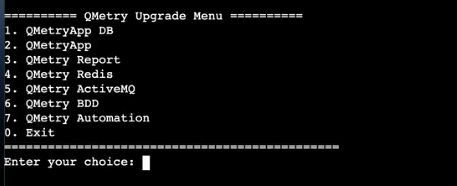
Type 2 to upgrade QMetry App.
Step 4: Restarting QMetry and MySQL Docker Container
Run the following command to list the running containers.
docker ps
Restart both Docker containers using the following commands:
docker stop qmetry_app_1 qmetryapp_db
docker start qmetryapp_db
docker start qmetry_app_1
Step 5: Install or Upgrade QMetry Jira Add-on
Download the correct Jira add-on version that matches your QMetry version. Refer to the table below to find the compatible Jira add-on version based on your QMetry version.
QMetry Version | Jira-addon version required |
|---|---|
8.27.x | 2.4.3_jira10 (Jira Version 10x), 2.4.3 (Jira Version 11x) |
8.26.x | 2.4.2_jira10 (Jira Version 10x), 2.4.2 (Jira Version 11x) |
8.25.x | 2.4.1 (Jira Version 11x), 2.4.1_jira10 (Jira Version 10x) |
8.24.x | 2.3.9_jira9 (Jira Version 9x), 2.3.9 (Jira Version 10x) |
In case you have not installed the QMetry Jira Integration app for integration, follow the Steps to Install and Configure the QMetry Jira Integration app, if it is not installed.
If you are upgrading from QMetry version 8.8.0 or lower, then Jira force sync is required. Follow the Jira Force Sync document.
Reconfiguring SSL After Upgrading QMetry to the Latest Version
If you have configured SSL (https) in Tomcat inside the container, you must reconfigure it in the new Docker container. For more information on configuring SSL, refer to the SSL Certificate Configuration for Tomcat in Docker document.
If you encounter any issues during the upgrade, please reach out to QMetry Support.