QMetry App Upgrade Document for Linux (from QMetry v8.16.0.1 and above)
Overview
This document is intended for users currently using QMetry v8.16.0.1 or later and provides step-by-step instructions to upgrade the QMetry Test Management application to version v8.27.0 on a Linux-based server.
System Requirements and Pre-requisites
Before upgrading, ensure the following:
Your current QMetry version is v8.16.0.1 or above. To check: Log in to QMetry and check the About section.
MySQL version of QMetry Reports and QMetry Application is 8.4.8
Internet connection is enabled on the server.
Upgrading QMetry from v8.16.0.1 and above to the Latest Version
To upgrade QMetry to the latest version, perform the following steps:
Important: Backup your Existing QMetry Database
To backup your existing QMetry database, perform the following steps:
Create a backup of the "qmetry" database. The backup is saved in /opt by default.
Run the following command to update the username, password, and location of the backup file:
docker exec qmetryapp_db sh -c 'exec mysqldump -uroot -p<password> --triggers --routines --hex-blob --single-transaction --lock-tables --no-create-db qmetry' > /opt/qmetry_backup_<date>.sql
Example 12.docker exec qmetryapp_db sh -c 'exec mysqldump -uroot -pqmetry --triggers --routines --hex-blob --single-transaction --lock-tables --no-create-db qmetry' > /opt/qmetry_backup_2021-01-01.sql
Verify that the database is backed up and is available.
Downloading the Upgrade Files
Download the required files by performing the following steps:
Get the latest version of QMetry Upgrade Installer from the QMetry Support Portal.
Download QMetry8270.zip to the QMetry Application Server on the host machine.
Step 3: Running the QMetry Upgrade
To run QMetry Upgrade, perform the following steps:
List the running containers using the following command:
docker ps
If Docker is not running, use the following command to start it:
docker start qmetryapp_db
docker start qmetry_app_1
Note
Replace the container names with the appropriate application names as specified in the previous command.
Go to the directory where the QMetry 8270.zip file is downloaded and copy the file inside the Docker container using the following command:
docker cp QMetry8270.zip qmetry_app_1:/opt
Log in to the Docker container using the following command:
docker exec -it qmetry_app_1 bash
Go to /opt directory where the QMetry 8270.zip file is copied using the command:
cd /opt
Unzip the file in the /opt directory, ensuring it is placed in a separate location from your current installation path (/home/qmetry/QMetry).
unzip QMetry8270.zip
Go to the QMetry directory:
cd QMetry8270
Grant execution permissions to the upgrade script:
chmod +x upgrade.sh
Execute the upgrade script:
./upgrade.sh
QMetry Upgrade Menu
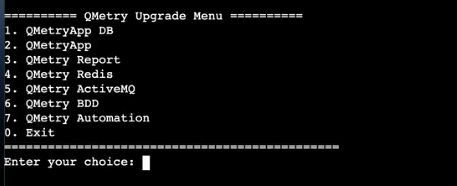
Type 2 to upgrade App DB.
Confirm to upgrade and then specify the path of the existing QMetry installation.
Note
The process may take some time to complete. Kindly be patient and allow it to finish properly.
Table 25. Upgrade QMetryOptions
Type
Default Value
Comments/ Example
Do you want to proceed with the QMetry upgrade (Y/N)?
Mandatory
-
type - Y/N
Exit from Docker container once the process is completed, use the following command:
exit
Step 4: Restarting QMetry and MySQL Docker Container
Run the following command to list the running containers:
docker ps
Restart both Docker containers using the following commands:
docker stop qmetry_app_1 qmetryapp_db
docker start qmetryapp_db
docker start qmetry_app_1
Step 5: Installing or QMetry QMetry Jira Add-on
Download the correct Jira add-on version that matches your QMetry version. Refer to the table below to find the compatible Jira add-on version based on your QMetry version.
QMetry Version | Jira-addon version required |
|---|---|
8.27.x | 2.4.3_jira10 (Jira Version 10x), 2.4.3 (Jira Version 11x) |
8.26.x | 2.4.2_jira10 (Jira Version 10x), 2.4.2 (Jira Version 11x) |
8.25.x | 2.4.1 (Jira Version 11x), 2.4.1_jira10 (Jira Version 10x) |
8.24.x | 2.3.9_jira9 (Jira Version 9x), 2.3.9 (Jira Version 10x) |
In case you have not installed the QMetry Jira Integration app for integration, follow the Steps to install and configure the QMetry Jira Integration app if it is not installed.
If you encounter any issues during the upgrade, please submit a support ticket on the Support Portal.